![White horizontal logo 1024x250.png]](https://emteria.com/hs-fs/hubfs/logos_emteria/White%20horizontal%20logo%201024x250.png?height=40&name=White%20horizontal%20logo%201024x250.png)
Many company networks restrict Internet access with a firewall. If your devices can't register, don't show up as online in the Emteria Hub, or don't receive updates, ask your network administrator to allow the hosts and ports below.
Hosts and ports used by Emteria
All connections are outgoing, from the device to our servers. Hosts marked as legacy are only used by older releases and apps.
| Host and IPs | Ports | Used for |
|---|---|---|
| api.emteria.com 142.132.247.171 2a01:4f8:c011:20f::1 |
443 (HTTPS) | Licensing, policies, products, provisioning, rollouts, settings, updates, network checks |
| s3.emteria.com 142.132.247.171 |
443 (HTTPS) | File storage, update downloads |
| a.eu-central-1.mdm.emteria.com 37.27.40.231 |
1883 (MQTT) 8883 (MQTTS) |
Device management |
| b.eu-central-1.mdm.emteria.com 95.216.171.225 |
1883 (MQTT) 8883 (MQTTS) |
Device management |
| a.us-east-1.mdm.emteria.com 178.156.218.97 |
1883 (MQTT) | Device management |
| emteria.com 88.99.92.166 2a01:4f8:10a:1ce5::2 |
443 (HTTPS) | Licensing, updates, provisioning, settings (legacy) |
| mdm.emteria.com 88.99.92.166 2a01:4f8:10a:1ce5::2 |
443 (HTTPS) |
Device registration, device management (legacy) |
| vnc.staging.emteria.com 46.4.72.150 |
8888 (VNC) | Screen mirroring (legacy) |
| apps.emteria.com 87.118.94.77 |
443 (HTTPS) | Private repositories, bug reports (legacy) |
Note: We may add or change used hosts. Please check this page regularly.
Check the connection from the device
Our apps have a built-in Network diagnostics screen. It tests from the device itself which of the connections above work, so you don't have to guess which rule is missing. It works before the device is registered, too.
- Open the Emteria Update app and tap the settings icon (⚙) in the top right corner.
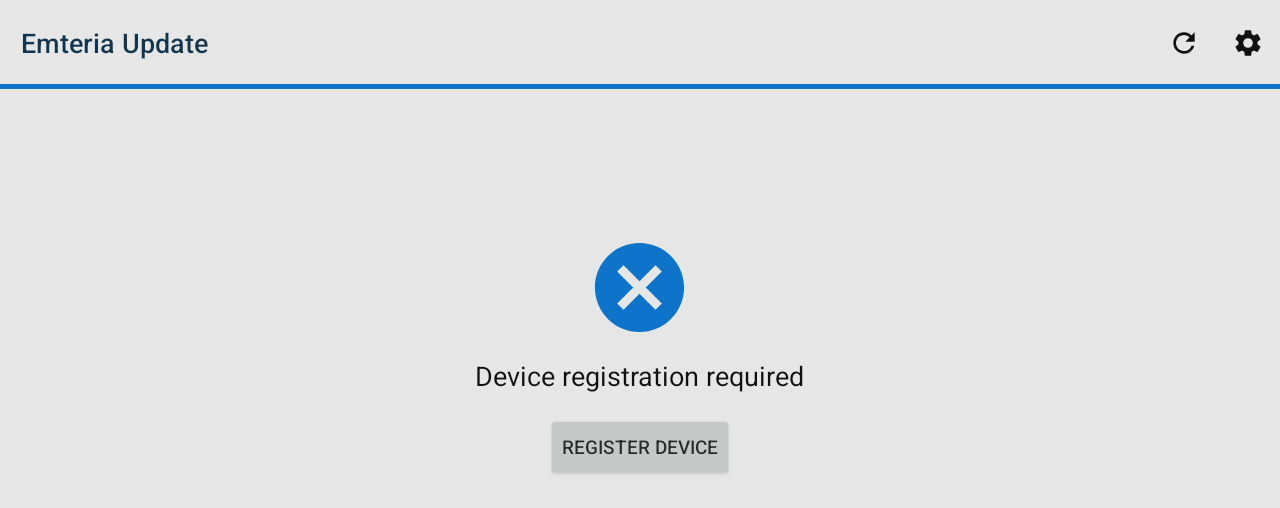
- Tap Manage account settings.
- Scroll down to System diagnostics and tap Network diagnostics.

- Tap Run tests. The checks take a few seconds. Tap a check to see its details.
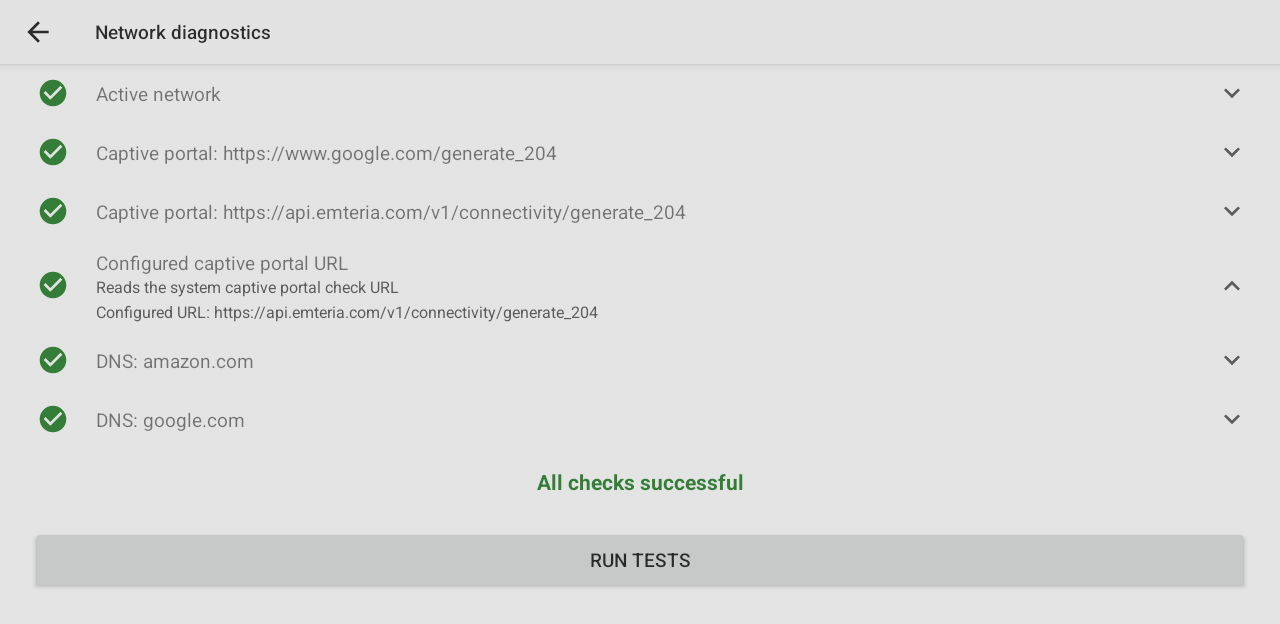
If a check fails, allow the host and port it names in your firewall. Still stuck? Send us a screenshot of the result with the failed checks opened.
You find the same screen in the Emteria MDM app under Manage device registration.
Note: Don't see the Network diagnostics entry on your device? Update your device or your application to the latest release.
Fix internal network validation
Every time a device connects to a network, Android checks whether it really has Internet access. For this check, it requests https://www.google.com/generate_204 by default and expects an empty answer (HTTP status 204). If requests to this domain are blocked, Android marks the network as connected without Internet access and shows an exclamation mark (!) next to the Wi-Fi or Ethernet icon.
In this restricted state, some parts of Android will refuse to work. For example, Android's Download Manager doesn't download files over such a network, even if the download server itself is still perfectly reachable. Many applications use the Download Manager, including some of our own Emteria apps. These applications can't download anything until Android has validated the network with this check.
Some company networks block all traffic to Google, for example in on-premise installations or hardened networks for increased data protection. This often causes problems with network validation even when all internal hosts and Emteria hosts are still allowed.
It can be fixed in two different ways:
- Allow www.google.com on port 443 (TCP/HTTPS) in your firewall, or
- Tell Android to use a different address for its check. You can use our address
https://api.emteria.com/v1/connectivity/generate_204, or your own: any other HTTPS address that answers with an empty response and status 204.
Only the HTTPS address decides whether Android treats the network as working. Android also contacts a few other Google addresses during the check. If your device shouldn't contact Google at all, change those too.
Change the address with ADB
Connect to the device with ADB and run:
adb shell settings put global captive_portal_https_url https://api.emteria.com/v1/connectivity/generate_204
Optional, so the device doesn't contact Google during the check at all:
adb shell settings put global captive_portal_http_url https://api.emteria.com/v1/connectivity/generate_204
adb shell settings put global captive_portal_fallback_url https://api.emteria.com/v1/connectivity/generate_204
adb shell settings put global captive_portal_other_fallback_urls https://api.emteria.com/v1/connectivity/generate_204
Use the https:// address in all four settings, also in the ones with "http" in their name. Then restart the device, or turn Wi-Fi off and on again. The exclamation mark should disappear. To check which address the device uses, run Network diagnostics (see above) and tap Configured captive portal URL.
The setting stays after a reboot. A factory reset removes it. To go back to the Android default, run adb shell settings delete global captive_portal_https_url (and the same for the other settings you changed).
Change the address on many devices with the Emteria Hub
Send the ChangeSetting command to a device or a group, with these values:
- Section: Global
- Type: String
- Key:
captive_portal_https_url - Value:
https://api.emteria.com/v1/connectivity/generate_204
Repeat the command for the optional settings above if you need them.
Note: Devices already need a working connection to the Emteria Hub to receive the command.