![White horizontal logo 1024x250.png]](https://emteria.com/hs-fs/hubfs/logos_emteria/White%20horizontal%20logo%201024x250.png?height=40&name=White%20horizontal%20logo%201024x250.png)
Android OS built by Emteria includes the SuShell App. It handles requests for root access, from your apps and from the ADB shell.
If your app needs root access, it calls the sushell command. The request goes to the SuShell App, which can show a confirmation dialog on the device screen. There you allow or deny the request and choose how long the permission lasts.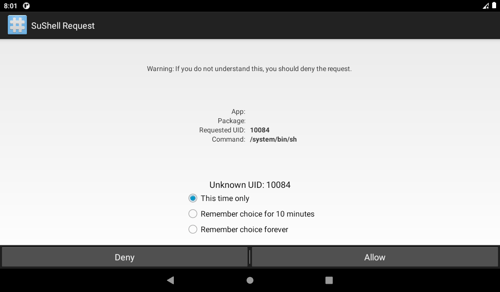
The SuShell App offers a log to see which app has been requesting the root permission in the past as well. To enable all SuShell request logging, check box in the Logging tab.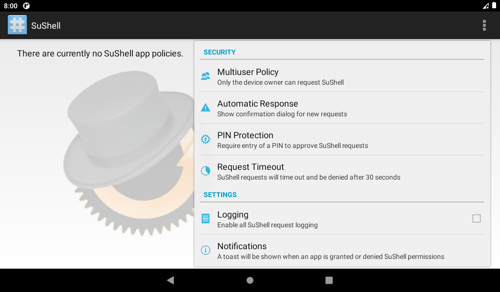
In addition, there are multiple setting that customize the SuShell App:
- Multiuser Policy: You can select who is able to request SuShell.
- Owner Only
- Owner Managed
- All Users
- Automatic Response: You can set up for requests to be automatically allowed or denied, or to be confirmed by you first.
- Pin Protection: Set up a password for SuShell requests.
- Request Timeout: Set the time when the request will time out.
Root access in the ADB shell
Our builds don't support adb root. To get a root shell, connect with ADB and type sushell:
adb connect 192.168.1.50
adb shell
sushell
Depending on the SuShell settings, a confirmation dialog can also appear here. If sushell seems to hang, check the device screen and allow the request.
Type exit to leave the root shell. You can also run a single command as root: sushell -c 'id'.
For a complete example, see How to run your own scripts at boot (init.d).